- All
- Product Name
- Product Keyword
- Product Model
- Product Summary
- Product Description
- Multi Field Search
Views: 846 Author: Site Editor Publish Time: 2026-05-20 Origin: Site
Have you noticed that the box for your new smartphone or earbuds keeps getting thinner and lighter? Gone are the days of bulky plastic trays, thick manuals, and excessive cushioning. Today, compact, “single-sheet” folding designs are taking over. This isn’t a coincidence – digital product packaging is undergoing a profound lightweight revolution.
The numbers tell the story: the global consumer electronics packaging market was valued at 25.4billionin2025andisprojectedtoreach25.4billionin2025andisprojectedtoreach77.5 billion by 2034, growing at a CAGR of 13.2%. Smartphone packaging alone was around 9.6billionin2025andisexpectedtoexceed9.6billionin2025andisexpectedtoexceed16 billion by 2035. The driving force? An urgent demand for protective, lightweight, and eco‑friendly packaging.
But lightweighting is far more than just “using less material”. It’s a convergence of material science breakthroughs, structural design ingenuity, tightening environmental regulations, brand value evolution, and shifting consumer expectations. In this article, we’ll dive into the key technologies shaping the lightweight packaging trend for digital products.

By 2026, sustainable packaging for electronics has moved from “nice‑to‑have” to mandatory compliance. The EU’s Packaging and Packaging Waste Regulation (PPWR (EU) 2025/40) , adopted in December 2024 and fully effective from August 12, 2026, replaces decades‑old directives. It explicitly requires all packaging to be recyclable or reusable, driving a rapid shift to paper‑based solutions.
Meanwhile, 14 U.S. states have passed Extended Producer Responsibility (EPR) laws for packaging. California’s SB 54 mandates that by 2032, 65% of plastic packaging sold in the state must be recyclable or compostable. Japan’s Act on Promoting Plastic Resource Circulation, South Korea’s K‑BPI certification, and Singapore’s mandatory packaging reporting system are creating a dense compliance network worldwide.
The most immediate business case for lightweight packaging is logistics savings. Take Nefab’s FiberFlute – a fully recyclable paper‑based cushioning alternative to PE foam. It cuts carbon emissions by 22% (saving 26 tonnes of CO₂ per year) and increases truck loading capacity by 280 packages per vehicle.
Amazon has achieved similar results by optimizing package dimensions, boosting pallet density, and shifting to lower‑carbon transport (sea freight emits ~95% less CO₂ than air freight), significantly reducing unit shipping costs.
Packaging is often the first tangible touchpoint for brand responsibility. Over 65% of smartphone manufacturers now use recyclable paper and molded fiber packaging. Adoption of minimalist packaging designs has increased by 50%, while consumer backlash against over‑packaging is translating into real purchase rejection rates. Lightweighting is no longer optional – it’s a competitive advantage.
The latest industry reports on electronics packaging lightweighting (2026) classify key technologies into three dimensions: material innovation, structural optimization, and process/model innovation. Together, they form a complete technical foundation.
Molded fiber, honeycomb structures, and plant‑based biomaterials are leading the way.
Molded Fiber is now widely adopted. Made from recycled paper pulp or wood pulp vacuum‑formed into custom shapes, molded fiber offers excellent cushioning and is 100% recyclable. Brother’s award‑winning molded fiber buffer reduces material usage by 33% (protecting only the four corners of a printer), shrinks the outer box by 7%, and cuts CO₂ emissions by 33%. Kyocera developed a cup‑shaped molded fiber buffer whose hollow structure delivers superior shock absorption, reducing cushioning material per device by 72%.
Apple has taken molded fiber to the extreme. The iPhone 17 Pro’s molded fiber tray is vacuum‑formed to a density approaching injection‑molded plastic – it holds the phone securely while absorbing transit shocks, performing structural roles once reserved for plastic with a much lower carbon footprint.
Honeycomb Structures leverage hexagonal geometry to distribute impact loads efficiently. Lightweight yet strong, they replace traditional foam and plastic fillers. The global honeycomb structural packaging market reached 6.07billionin2025andisexpectedtogrowto6.07billionin2025andisexpectedtogrowto17.72 billion by 2032. Beyond paper honeycomb, research into bio‑based and compostable materials – mycelium composites, nanocellulose fiberboard, algae‑based films, and bio‑PE (from sugarcane) – is accelerating toward commercial reality.
If material innovation answers what to use, structural optimization answers how to use it smarter.
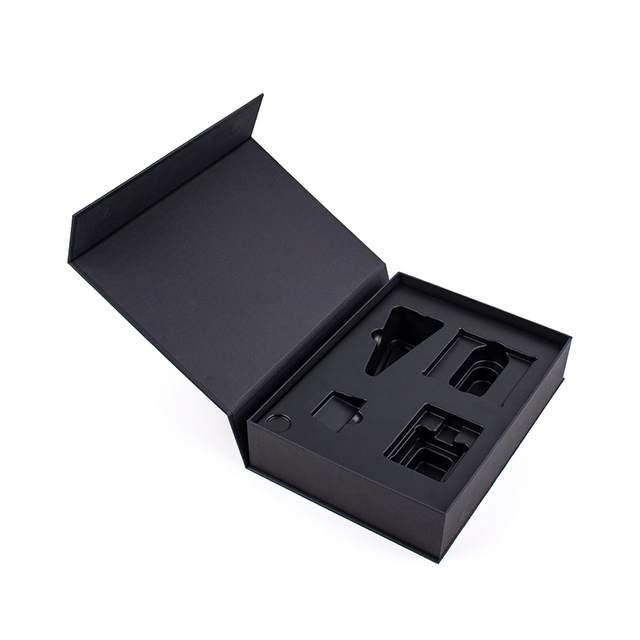
One‑Paper Box is a shining example. Xiaomi’s “One Paper Box” is folded from a single sheet of cardboard or corrugated board – no glue, no extra filler, and up to 40% lower cost than traditional packaging. It won Japan’s Good Design Award Best 100 and the German iF Design Award. The core principle: precise folding turns the paper itself into both outer box and internal cushioning.
Glue‑free Cushioning Structures eliminate adhesives. New “fold‑and‑lock” designs assemble without glue. Corner protectors lock by rolling, offering all‑angle impact protection. “Reduced material cushion structures” achieve 97% material utilization and are made entirely of corrugated board.
Precision Fit Design – the “+5mm rule” is now industry best practice. Keeping internal dimensions to product size plus about 5 mm prevents both damage and wasted space. Combined with 3D scanning and modeling, custom‑fit packaging eliminates every cubic millimeter of redundancy.
Sometimes the smartest reduction is to not need the material at all.
Removing Unnecessary Accessories – Apple stopped including charging bricks from the iPhone 12 series and eliminated plastic shrink wrap from the iPhone 13 series onward, reducing plastic use by 600 tonnes per year just from shrink wrap. Apple’s latest packaging is nearly half the size of its decade‑ago predecessor, with all plastic components replaced by laminated paperboard and molded fiber.
Secondary‑Life Packaging – Acer’s gaming series boxes can be transformed into headphone stands, desk organizers, or laptop cooling stands after unboxing, extending the packaging’s functional life.
Ships‑In‑Own‑Container (SIOC) – Designed for e‑commerce, SIOC reduces secondary packaging, lowers shipping weight, and improves warehouse density. Brands adopting lightweight e‑commerce packaging report 15% lower logistics costs and 40% fewer returns due to package damage.
Apple – From Over‑packaging to Fiber‑Based Mastery
The evolution of Apple’s packaging is a lightweighting timeline. The original iPod came packed in a sea of plastic and foam. Today, the iPhone 17 Pro box is nearly 50% smaller, entirely fiber‑based, and has cut plastic content by 20 percentage points since 2015. Apple is on track to eliminate all plastic from its packaging by the end of 2025.
Microsoft – Engineering the Plastic‑to‑Paper Transition
Microsoft’s “Project Alder” shows the complexity of switching from plastic to 100% paper. Challenges: moisture resistance, abrasion protection, electrostatic discharge, and particle contamination. The team solved them by rethinking protection from a systemic engineering perspective – not just swapping materials but redesigning the entire protective logic.
Xiaomi – Low‑cost “One Paper Box” Revolution
Designing a packaging solution that passes all drop and vibration tests using just a single sheet of cardboard demonstrates structural creativity at its best. Xiaomi’s approach offers a replicable, low‑cost lightweighting template for the industry.
Amazon – 30% More Recycled Fiber + 60% Less Ink
Amazon’s new packaging design incorporates an average of 30% more recycled fiber, reduces reliance on virgin and bleached fibers, and cuts ink usage by 60% – a perfect illustration of minimalist design executed at scale.
Despite clear progress, three major challenges remain.
Technical hurdles: Moisture resistance, anti‑static properties, and long‑term strength of paper‑based alternatives still need improvement. As Microsoft engineers noted, “Plastic is not paper, and paper is not plastic – they behave completely differently.” Under extreme conditions (85% humidity, 55°C), paper strength remains a work in progress.
Cost challenges: Some novel sustainable materials have higher upfront costs than legacy plastics. Mycelium composites cost 18–25% more than EPS; nanocellulose fiberboard can be 30–40% more expensive. However, as Apple and Xiaomi have shown, structural optimization and scaling adoption gradually absorb these premiums.
Regulatory pressure: PPWR’s full implementation will demand even higher recyclability rates, with heavy fines for non‑compliance.
Future directions:
Intelligent packaging – NFC tags and QR codes replace paper manuals, providing digital product info and interactive tutorials.
AR‑enhanced packaging – Augmented reality creates immersive unboxing experiences, boosting brand differentiation.
“Carbon‑negative” packaging – Compostable materials (e.g., seaweed‑based films, mycelium) could enable a zero‑waste closed loop for digital product packaging.
Lightweight design for digital product packaging boxes is far more than “just using less”. It is a systemic transformation across materials, structures, logistics, user experience, and brand values. When Apple turns its box into a “miniature hardcover book”, when Xiaomi supports an entire package with a single sheet of cardboard, and when Microsoft engineers a plastic‑to‑paper migration with systemic thinking – we see not only technical refinement but a philosophical shift.
The new formula for lightweight packaging is becoming clear:
Minimal resources × Maximum structural intelligence = Optimal user experience + Minimum environmental load
Tomorrow’s packaging will be not only light but also smart – protecting products, building emotional brand connections, and lightening the load on our planet. That is the ultimate meaning of the lightweight packaging revolution for digital products.