- All
- Product Name
- Product Keyword
- Product Model
- Product Summary
- Product Description
- Multi Field Search
Views: 578 Author: Site Editor Publish Time: 2026-09-16 Origin: Site
The advent calendar market has transformed from a simple chocolate countdown into a high-stakes packaging engineering challenge. In 2025, brands including MAC, Armani Beauty, Jo Malone, Dior, and Benefit all released advent calendars with genuinely innovative structural packaging — tiered drawers, rotating compartments, and limited-edition wooden trunks with custom gold hardware. For brands at every tier, the packaging investment directly affects sell-through, social sharing, and brand perception.
But finding the right manufacturing partner is where most first-time advent calendar projects stumble. Unlike standard gift boxes, advent calendar packaging is structurally complex, requires long lead times, and must be ordered months before the selling season begins. This guide walks you through the complete sourcing process — from defining your product map to evaluating factories and placing your first order.

The single most common mistake brands make is approaching a manufacturer with a design concept before they have finalized their product assortment. The best custom Advent calendar packaging begins with the products inside — not the Christmas artwork outside.
Create a product map covering every item in the calendar. Do not assume that one compartment can be repeated 24 times unless the products are genuinely identical in size and weight. For each item, record:
Final packaged dimensions and weight
Orientation inside the calendar
Fragility or leakage risk
Whether the item is individually wrapped
Whether any packaging component will touch food directly
Preferred opening date and position
This information determines cavity dimensions, board thickness, tray geometry, opening direction, and overall calendar size. A cavity that is too tight can make items difficult to remove, while excessive space allows movement and makes the calendar feel poorly engineered.
The structural format you choose determines cost, complexity, and the unboxing experience you can deliver. Here is how the main options compare:
Structure | Best For | Relative Cost | Typical MOQ |
|---|---|---|---|
Numbered Door Box | Entry/mid-tier brands, high volume | Low–Medium | 1,000–3,000 |
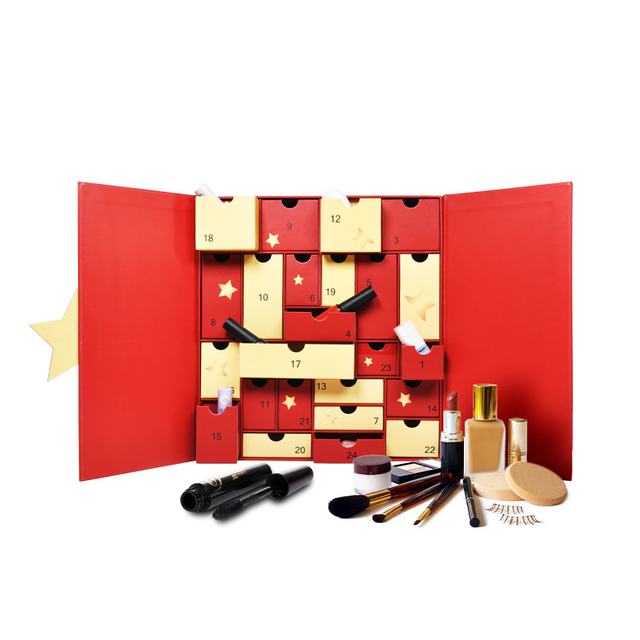
Multi-Drawer Tower | Skincare and cosmetics sets | Medium | 500–1,000 |
Book-Format with Compartments | Premium gifting, storytelling brands | Medium–High | 500–1,000 |
Rotating/Spin Structure | Luxury tier, hero SKU launches | High | 500–1,000 |
House/3D Shaped Box | Limited edition, collector's items | High | 500–1,000 |
Reusable Rigid Chest | Luxury and premium tier | Very High | 300–500 |
Source: PackYourBrand structural comparison for beauty advent calendars
For most brands entering the advent calendar category for the first time, a multi-drawer tower or book-format with compartments offers the best balance of visual impact, structural integrity, and manageable cost-11. The rotating and 3D formats are best reserved for brands with an established calendar program and the budget to support a more complex engineering brief.

Platforms like Alibaba, Made-in-China, and ThomasNet list packaging manufacturers with detailed profiles for comparison. When searching, use specific terms such as "custom advent calendar box manufacturer," "advent calendar packaging supplier," or "multi-drawer calendar box OEM". Focus on suppliers with strong portfolios and positive feedback.
China remains the global epicenter for high-volume, cost-effective packaging production, particularly for complex holiday items such as advent calendars and themed gift sets-. The majority of manufacturers are concentrated in Guangdong province (Dongguan, Shenzhen, Guangzhou), with additional clusters in Xiamen and Shanghai.
Packaging trade shows such as Pack Expo and Luxepack connect brands directly with manufacturers. Industry colleagues and packaging consultants can also provide recommendations that reveal details online research might miss — such as delivery reliability and customer service quality.
Some agencies specialize in sourcing packaging from Asian manufacturers and can manage the entire process — from structural design to quality inspection. This option is particularly useful for brands without existing supplier relationships in China.
Once you have a shortlist, assess each factory against these criteria:
Check whether the supplier has access to both offset and digital printing, automated die-cutters, foil stamping machines, and window patching systems-. Ask whether they can handle rapid prototyping (within 48 hours) and scale up to 500,000 units monthly.
Look for FSC certification (for sustainable paper sourcing), ISO 9001 (quality management), and BSCI (social compliance). For markets requiring food-contact packaging, verify that the factory holds relevant food-grade certifications. If you are selling into the EU, confirm that the manufacturer understands EU packaging compliance requirements — this is non-negotiable for beauty and confectionery brands.
Typical MOQs for custom advent calendar boxes range from 300 to 1,000 pieces, depending on structure complexity. Price ranges vary widely: simple numbered-door boxes can start at $0.15–$1.50 per unit, while premium multi-drawer rigid boxes with soft-touch lamination and gold foil stamping typically fall in the $1.50–$5.00 range.
Cost Factor | Impact |
|---|---|
Structure complexity | Rigid boxes cost 2–4x more than folding cartons |
Printing method | Offset is cheaper for high volume; digital for small runs |
Finishes | Foil stamping, embossing, and soft-touch add 15–30% |
Insert design | Custom foam or molded pulp inserts add cost and lead time |
Order quantity | Unit price drops significantly at 1,000+ units |
Prioritize suppliers with sub-5-hour average response times. Some top-rated manufacturers offer ≤2-hour responses and full graphic proofing services. Test this before committing — send a detailed inquiry and measure how quickly and thoroughly they reply.
Always request a physical sample before placing a production order. Sample costs typically range from $6 to $150, often refundable upon order-. Evaluate material durability, print fidelity, assembly integrity, and how the drawers or doors actually open and close.

A typical custom advent calendar box project follows this timeline:
Phase | Duration | What Happens |
|---|---|---|
Design & 3D mockup | 3–5 days | Submit theme ideas; receive 3D renderings with dimensions |
Physical sampling | 7–10 days | Factory produces a physical sample for approval |
Artwork revision | 3–7 days | Adjust dielines, print files, and structural details |
Production | 15–35 days | Full-scale manufacturing after sample approval |
Shipping | 3–30 days | Air (3–7 days) or sea (20–30 days) depending on destination |
Sources: Guangdong Gumo Crafts customization timeline-; UColorPrint production lead times
For December 1 availability, most manufacturers recommend placing your order no later than the end of September. Some factories can accommodate rush orders, but expect premium pricing and limited structural options.
Before you commit to production, ask every shortlisted manufacturer the following:
Can you provide a complete dieline and 3D structural proof before sampling? — This reveals whether they have in-house structural engineering capability or are simply a print shop.
What is your actual production capacity for advent calendar boxes during peak season (August–November)? — Many factories run at full capacity during this window.
Do you have experience with food-contact packaging and relevant certifications? — Essential if your calendar contains chocolates or edible items.
What are your quality control procedures at each production stage? — Ask about AQL inspection standards and whether third-party inspection is permitted.
Can you provide references from brands in my product category? — Past experience with similar products reduces risk significantly.
What happens if there is a defect or delay? — Understand their policy on rework, refunds, and expedited shipping costs.

Designing around the artwork instead of the products. The numbered doors are the most visible feature, but the internal compartment system determines whether the calendar actually works.
Choosing the cheapest quote without evaluating capability. A $0.50 unit price is meaningless if the factory cannot handle your drawer configuration or finish requirements.
Underestimating lead times. Advent calendar production peaks between August and November. Factories that are responsive in June may become unresponsive in September.
Skipping the physical sample. Digital proofs cannot reveal structural weaknesses, drawer alignment issues, or material quality problems.
Ignoring shipping carton design. A beautifully constructed advent calendar can arrive damaged if the outer shipping carton is not engineered for the weight and fragility of the filled unit.
Finding the right custom advent calendar box manufacturer is a structured process, not a one-off transaction. Start with a complete product map, choose a structure that matches your brand tier and budget, evaluate factories on production capability and communication responsiveness, and always test with a physical sample before committing to full production.
The brands winning in the advent calendar category are not necessarily spending the most — they are planning the earliest, briefing the most thoroughly, and partnering with manufacturers who understand that the box is the product. For a seasonal format where packaging directly drives sell-through and social sharing, that preparation is the difference between a calendar that sells out and one that sits in a warehouse.