- All
- Product Name
- Product Keyword
- Product Model
- Product Summary
- Product Description
- Multi Field Search
Views: 546 Author: Site Editor Publish Time: 2025-11-10 Origin: Site
Market research data shows that 60% of consumers are willing to pay 10% more for eco-friendly packaging. As environmental consciousness becomes a key factor in purchasing decisions, how should your gift box respond?
In today's cosmetics market, sustainable gift boxes have evolved from a marketing gimmick into a powerful brand asset and growth engine. It's more than just a material substitution; it's a systematic overhaul involving brand values, user experience, and supply chain transformation. This article reveals effective strategies for creating successful sustainable cosmetic gift boxes.

Material selection is the most direct manifestation of a sustainable gift box and the first presentation of a brand's environmental commitment.
Bio-based and Biodegradable Materials: Utilizing packaging materials made from agricultural by-products like sugarcane bagasse and corn starch achieves a closed-loop cycle of "from nature, back to nature." For instance, the "Pat Cube" gift box uses naturally degradable sugarcane pulp, which leaves no residue or pollution after decomposition.
Application of Recycled Materials: The use of Post-Consumer Recycled (PCR) plastic and post-consumer recycled fiber has become industry practice. For example, the Fasson ® rCrush Grape FSC® material used in a certain series contains 40% post-consumer recycled fiber. Brands like Dior have also adopted 100% plant-based, recyclable packaging.
FSC-Certified Paper and Eco-Friendly Inks: Sourcing FSC (Forest Stewardship Council) certified paper ensures the wood pulp originates from sustainably managed forests. Simultaneously, using eco-friendly inks for printing further reduces the environmental impact of the printing process.
Sustainable design also focuses heavily on user experience, achieving a balance between environmental protection and aesthetics through meticulous structural design.
Simplified Structure and Monomaterial Design: Moving away from complex multi-layer structures and mixed materials, prioritizing monomaterial design significantly enhances packaging recyclability. A notable example is a new packaging box developed through a collaboration, which achieved an eco-upgrade by removing magnets and stickers and using 100% FSC-certified recycled paper.
Refill Systems and Circular Models: Introducing refillable options is one of the most effective ways to reduce resource consumption. According to Nielsen data, market interest in refillable products has surged by 64%. Refillable solutions for cosmetic products are becoming more common.
Encouraging Reuse and Multifunctional Design: Giving gift boxes a second life greatly enhances their environmental value and consumer engagement. For example, some gift boxes can be repurposed as backpacks or storage boxes, while others are designed to be used as mini vases or jewelry stands after their primary function.
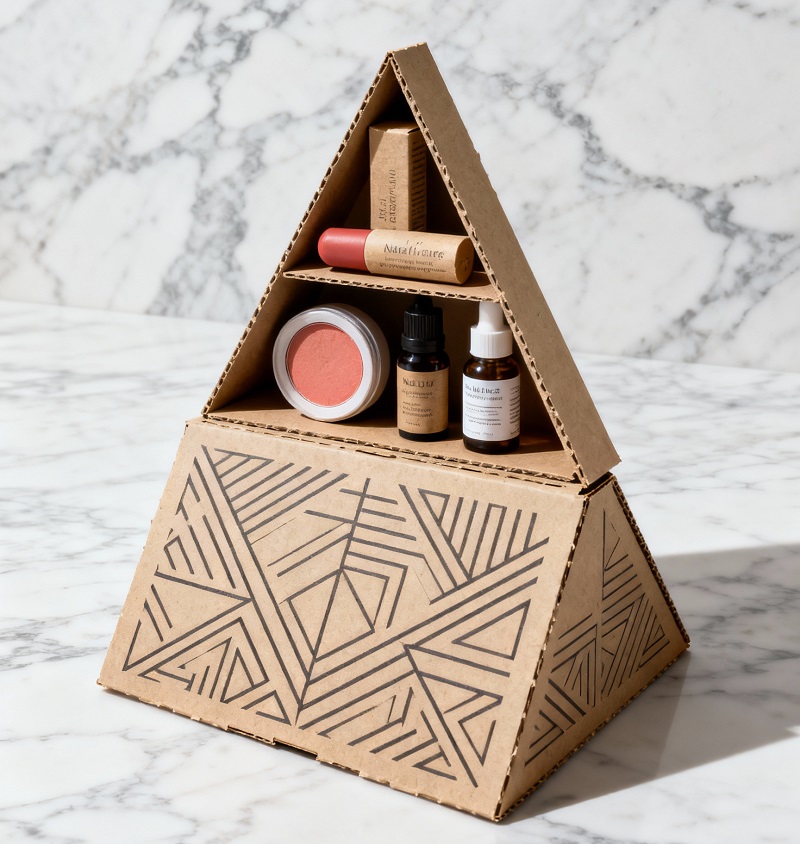
Even the best sustainable practices need effective communication to reach consumers and translate into market recognition.
Transparent Storytelling and Certification Labels: Proactively and clearly communicate the eco-friendly materials, recyclability, and obtained eco-certifications (like FSC) of the gift box. This not only educates consumers but also builds trust. Some brands clearly convey their environmental philosophy, such as using reclaimed wood and participating in tree-planting initiatives.
Creating an Immersive Unboxing Experience: Design the unboxing process as a ritualistic journey of environmental education. For instance, setting up interactive stations at pop-up events allows consumers to learn key steps of plastic recycling, thereby enhancing the brand's sustainable image.
Integrating Take-Back Schemes and Incentive Systems: Implementing empty container recycling programs and offering rewards like points to consumers can effectively increase packaging recovery rates and enhance user loyalty. Successful take-back programs have attracted significant consumer participation and demonstrated a strong brand commitment to sustainability.
Leveraging Social Media Communication: Design gift boxes with high visual appeal and interactive fun, encouraging users to share their unboxing experiences on social media. Unique packaging designs have sparked spontaneous unboxing topics on social platforms, achieving viral spread.
Sustainable innovation is rapidly evolving. The following trends deserve brands' early attention and adoption.
Smart Packaging Empowerment: By integrating QR codes, brands can provide consumers with product traceability information, AR try-on experiences, or skincare tutorials, enhancing transparency and user interaction simultaneously.
Advancements in Bio-based Materials: Innovative material companies are offering advanced bio-based materials that can replace traditional ABS plastic. These materials combine luxury aesthetics, good functionality, and recyclability or compostability, without leaving behind permanent microplastics.
Exploring Closed-Loop Systems: Brands are actively working to build more comprehensive recycling ecosystems, such as partnering with supply chain partners to use reusable shipping boxes or packaging, thereby reducing the environmental footprint on a broader scale.
A successful sustainable cosmetic gift box is far from a simple material swap. It is the perfect integration of materials science, structural design, marketing strategy, and supply chain management. In an era where consumption upgrades coexist with environmental awareness, transforming sustainable gift boxes from a "cost center" into a "value growth driver" for the brand can not only win market share but also contribute goodwill to the planet, achieving a win-win situation for commercial value and social responsibility.
Take action now: Starting with your next product iteration, try introducing one renewable material or optimizing the structure of one packaging design. Let your brand become an active participant and shaper of the future of sustainable beauty.